Medicare Planning in 2026: Costs, Enrollment Timelines, and Traps That Could Cost You Thousands
Pamela Rodriguez, CFP® ·
Quick Answer: Medicare is not free and not automatic. The standard Part B premium in 2026 is $185/month per person - but high earners can pay up to $628.90/month through IRMAA surcharges. Missing your enrollment window triggers a permanent 10% penalty per year late. Most people need to make a Medicare decision starting three months before their 65th birthday.
Table of Contents
- What Does Medicare Actually Cover in 2026?
- When Do You Need to Enroll in Medicare?
- What Is IRMAA and How Does It Affect Your Medicare Premiums?
- Should You Choose Original Medicare or Medicare Advantage?
- Does Medicare Cover Long-Term Care Costs?
- How Much Should You Budget for Healthcare in Retirement?
- ORO and Employee Benefits Clarity
- Your Medicare Planning Checklist
- Frequently Asked Questions
Here is a scenario I see more often than I should: A 65-year-old retires in January, assumes Medicare will kick in automatically, doesn't enroll during the required window, and gets hit with a 10% permanent penalty on Part B premiums for every 12-month period they were late enrolling. They were trying to do the right thing - waiting until they needed coverage. Instead, they pay a higher premium every single month for the rest of their life for a mistake that takes about 10 minutes to avoid.
Medicare planning affects every American who reaches 65 - and the rules are genuinely complicated. The costs are significant, the deadlines are strict, and the choices you make at enrollment can follow you for decades. I am going to walk you through all of it right now.
What Does Medicare Actually Cover in 2026?
Medicare has four main parts, and understanding what each covers is the foundation of good planning (Medicare.gov: What Medicare Covers):
Part A covers hospital inpatient care, skilled nursing facility stays (limited), hospice, and some home health care. Most people receive Part A premium-free if they or their spouse paid Medicare taxes for at least 10 years (40 quarters). If you don't qualify for premium-free Part A, you pay up to $518/month in 2026.
Part B covers outpatient care: doctor visits, preventive services, lab tests, durable medical equipment, and outpatient surgery. Part B always has a premium. The standard premium in 2026 is $185/month per person (CMS.gov 2026 Medicare Costs). Higher earners pay more through IRMAA - covered in detail below.
Part D covers prescription drugs. It is technically optional, but if you skip it and later need drug coverage, you will face a late enrollment penalty for every month you were eligible but not enrolled.
Part C (Medicare Advantage) is an alternative to Original Medicare offered through private insurers approved by Medicare. It bundles Parts A, B, and usually D into one plan, often with extras like dental and vision.
What Medicare does NOT cover:
- Most dental care (cleanings, fillings, extractions, dentures)
- Routine vision care (glasses, contact lens exams)
- Hearing aids and exams
- Long-term custodial care - this is one of the most dangerous misconceptions in retirement planning
- Most care received outside the United States
If you plan to travel internationally, budget for dental, vision, and hearing costs separately. They do not disappear because Medicare exists.
When Do You Need to Enroll in Medicare?
Missing enrollment windows is the single most expensive Medicare mistake people make. Here are the key dates (SSA.gov Medicare Enrollment):
Initial Enrollment Period (IEP): A 7-month window that starts 3 months before the month you turn 65, includes your birth month, and ends 3 months after. This is your primary opportunity to enroll in Parts A and B without penalty.
Special Enrollment Period (SEP): If you are actively working at 65 and covered under an employer group health plan (your own or a spouse's), you can delay Medicare enrollment without penalty. The SEP gives you 8 months after employment ends - or employer coverage ends - to enroll.
Critical rule: COBRA does NOT qualify as employer coverage for this purpose. If you turn 65, leave your job, and go on COBRA, you are not in a Special Enrollment Period. You must enroll in Medicare during your IEP or face permanent late enrollment penalties.
General Enrollment Period (GEP): If you missed your IEP and do not qualify for a SEP, you can enroll during the GEP from January 1 - March 31 each year, with coverage starting July 1. But you will pay the late enrollment penalty permanently.
The Late Enrollment Penalty: For each 12-month period you were eligible but did not enroll in Part B, your monthly premium increases by 10% - permanently. Two years late means 20% extra for life. On a $185/month premium, that is $37/month more, or $444/year, every year until you die. This is avoidable. It requires only that you know the rule.
What Is IRMAA and How Does It Affect Your Medicare Premiums?
IRMAA - the Income-Related Monthly Adjustment Amount - is a Medicare premium surcharge applied to higher-income beneficiaries. It applies to both Part B and Part D premiums, and it blindsides a significant number of my clients who didn't plan for it.
Here is how it works: Medicare looks at your Modified Adjusted Gross Income (MAGI) from two years prior to determine your current year's premium (CMS IRMAA Thresholds 2026). Your 2026 premiums are based on your 2024 income.
2026 IRMAA tiers for Part B (per person):
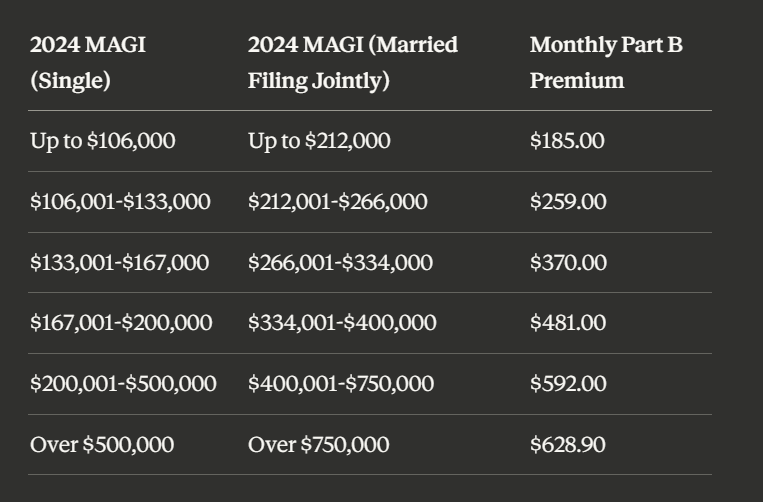
A married couple at the top tier pays over $1,257/month in Part B premiums alone - nearly $15,000 per year - before Part D, copays, or supplemental coverage.
The Roth conversion and IRMAA trap: If you do a large Roth conversion at age 63 and push your MAGI above an IRMAA threshold, you will pay higher Medicare premiums at 65 - two years later. Pre-retirement income management directly determines Medicare cost. This is why integrated retirement income planning matters.
You can appeal IRMAA after a life-changing event: If your income has dropped significantly due to retirement, job loss, divorce, or death of a spouse, you can appeal your surcharge using Form SSA-44. Many people overpay for years simply because they do not know this is possible.
Should You Choose Original Medicare or Medicare Advantage?
This is the most consequential healthcare decision you will make at 65. Both options cover the same core services, but the structure, costs, and trade-offs are very different.
Original Medicare + Medigap:
- Access to any doctor or hospital in the U.S. that accepts Medicare - no network restrictions
- Medigap (supplemental) plans cover deductibles, coinsurance, and copays, giving you highly predictable out-of-pocket costs
- Generally higher monthly premiums (Medigap plans run $150-$400+/month depending on plan type, age, and location)
- Requires separate Part D plan for drug coverage
- Best for: frequent travelers, people with complex or chronic conditions, those who value provider choice
Medicare Advantage (Part C):
- Offered by private insurers approved by CMS
- Often includes dental, vision, and hearing - benefits not in Original Medicare
- Usually lower or $0 monthly premiums
- Restricted to network providers (HMO or PPO structures)
- Out-of-pocket maximums can be high - up to $9,350 in-network and $14,000+ out-of-network in 2026
- Prior authorization requirements can delay care
- Best for: healthier beneficiaries, those who stay local, people on tighter budgets
The switching trap you need to know: If you start on Medicare Advantage and later want to switch to Original Medicare plus a Medigap plan, you may not be able to get Medigap at standard rates. In most states, insurers can medically underwrite applicants outside their initial enrollment window - meaning pre-existing conditions can result in higher premiums or denial of coverage. If Medigap is right for you, enroll when you are first eligible.
Does Medicare Cover Long-Term Care Costs?
No. This is one of the most dangerous misconceptions in retirement planning, and it costs families enormously.
Medicare does not pay for long-term custodial care - the care you need when you can no longer perform daily activities like bathing, dressing, or eating independently. Medicaid pays for long-term care, but only after you have spent down most of your assets to near-poverty thresholds.
The average annual cost of a private room in a nursing facility in 2026 is approximately $110,000-$130,000 per year, according to Genworth's Cost of Care Survey. Home health aide care runs $25-$35/hour - often totaling $50,000+ per year for part-time services.
Long-term care insurance, hybrid life/LTC policies, or dedicated self-insurance strategies are the real solutions for this risk. It belongs in every retirement plan that is being done honestly.
How Much Should You Budget for Healthcare in Retirement?
According to Fidelity's 2025 Retiree Health Care Cost Estimate, a 65-year-old couple retiring today can expect to spend approximately $330,000 on healthcare costs over their lifetime - not including long-term care.
Broken down, that is roughly $13,000-$16,000 per year per couple in today's dollars. Factored into a comprehensive retirement income plan, it is manageable - but only if you plan for it deliberately. The mistake is assuming Medicare handles everything and building a retirement budget that treats healthcare as nearly free.
Healthcare inflation also runs 2-3% above general inflation over time. A cost that feels manageable at 65 can feel crushing at 82 if you did not stress-test it in your projections.
ORO and Employee Benefits Clarity
One of the features I built ORO (oroworks.com) to address is the gap between what employees think their retirement healthcare will cost and what it actually will. Most workers have no visibility into how Medicare premiums, IRMAA risk, and long-term care costs interact with their retirement savings. ORO's financial decision engine surfaces this picture at the employee level - before it becomes a retirement crisis. If you are an HR or benefits leader who wants to give your workforce that kind of clarity, ORO is worth a conversation.
Your Medicare Planning Checklist
- At age 63: Model your projected income at 65 against the IRMAA thresholds. If you are doing Roth conversions, factor in the two-year IRMAA lookback.
- At age 64: Compare Original Medicare + Medigap vs. Medicare Advantage. Get quotes from an independent Medicare specialist - not a captive agent for one carrier.
- 3 months before your 65th birthday: Your Initial Enrollment Period begins. Do not wait until your birthday month.
- If still working at 65: Confirm with HR in writing that your employer plan qualifies as creditable coverage for Medicare SEP purposes.
- Every October 15 - December 7: Review your Part D and Medicare Advantage plan during Open Enrollment. Plans change annually. Your current plan may no longer be your best option.
Medicare is not a set-it-and-forget-it decision. It requires proactive management every year and a long-term planning lens from the moment you turn 63.
Schedule your free retirement planning consultation at goldenwealthcapital.com/free-consultation. I will help you build healthcare costs into your retirement income plan so there are no expensive surprises.
Frequently Asked Questions
When should I sign up for Medicare?
Sign up during your 7-month Initial Enrollment Period, which begins 3 months before the month you turn 65. If you are still working and covered by an employer plan, you may delay without penalty - but confirm with HR first and never rely on COBRA as a substitute.
How much does Medicare cost per month in 2026?
The standard Part B premium is $185/month per person. Higher earners pay more through IRMAA surcharges that range from $259 to $628.90/month depending on income. Part A is premium-free for most people. Part D premiums vary by plan.
What is the Medicare late enrollment penalty?
For Part B, the penalty is 10% of the standard premium for every 12-month period you were eligible but did not enroll. It is permanent - you pay it every month for the rest of your life.
What does Medicare not cover?
Medicare does not cover routine dental, vision, hearing, long-term custodial care, or most care outside the U.S. These are significant gaps that require separate planning.
What is IRMAA and can it be reduced?
IRMAA is a surcharge added to Part B and Part D premiums for higher-income beneficiaries, based on income from two years prior. If your income has dropped due to retirement, divorce, or another life-changing event, you can appeal using Form SSA-44 at SSA.gov.
Is Medicare Advantage better than Original Medicare?
It depends on your health, budget, and where you live. Medicare Advantage tends to have lower premiums but network restrictions and prior authorization requirements. Original Medicare offers broader provider access and more predictable costs when paired with a Medigap plan.
About Pamela Rodriguez, CFP®
Pamela Rodriguez is the founder and lead financial planner at Golden Wealth Capital (goldenwealthcapital.com), a fee-only, fiduciary financial planning firm based in Sacramento, CA, serving clients nationwide. She is also the founder of ORO (oroworks.com), an AI-powered financial decision engine for employers and their workforces. A graduate of the University of Chicago Booth School of Business, Pamela has been featured in the Wall Street Journal, CNBC, Fox News, Yahoo Finance, and US News. She serves as Board Treasurer of the Financial Planning Association of Northern California.
Legal Disclaimer: This blog post is for educational and informational purposes only and does not constitute individualized financial, tax, or legal advice. Medicare rules, premiums, and IRMAA thresholds change annually. Consult a qualified financial planner and a licensed Medicare specialist for personalized guidance. Golden Wealth Capital is a registered investment adviser. Full disclosures at goldenwealthcapital.com.
Sources: Medicare.gov: What Medicare Covers | CMS 2026 Medicare Premiums | SSA.gov Medicare Enrollment | Fidelity 2025 Retiree Health Care Cost Estimate | Genworth Cost of Care Survey
Related Topics: Social Security claiming strategy | IRMAA and Roth conversion planning | Long-term care insurance | Retirement income planning | Medicare Supplement plan comparison | Estate planning for retirees